








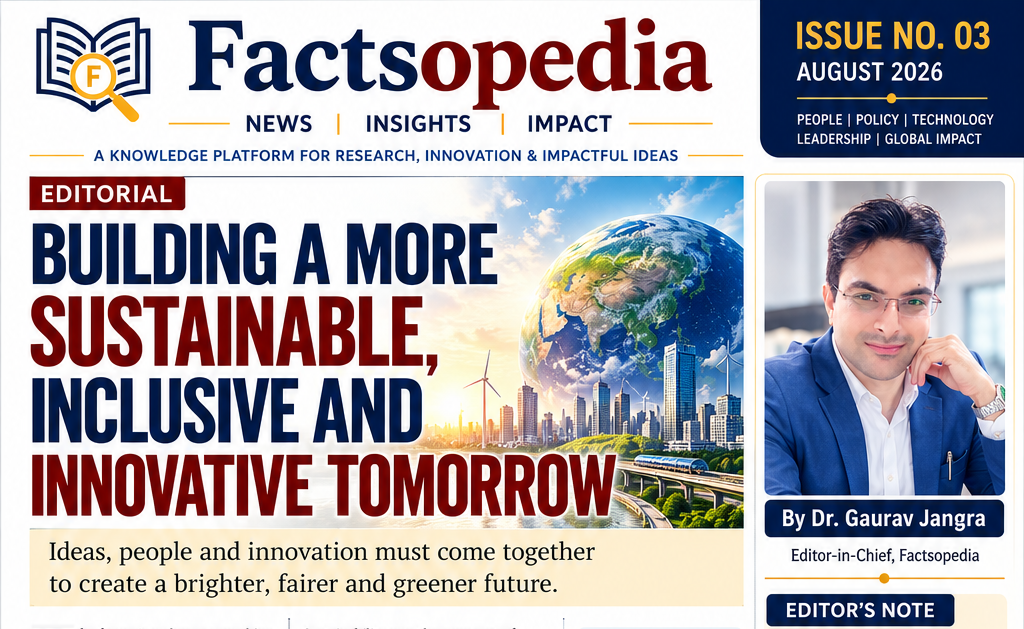
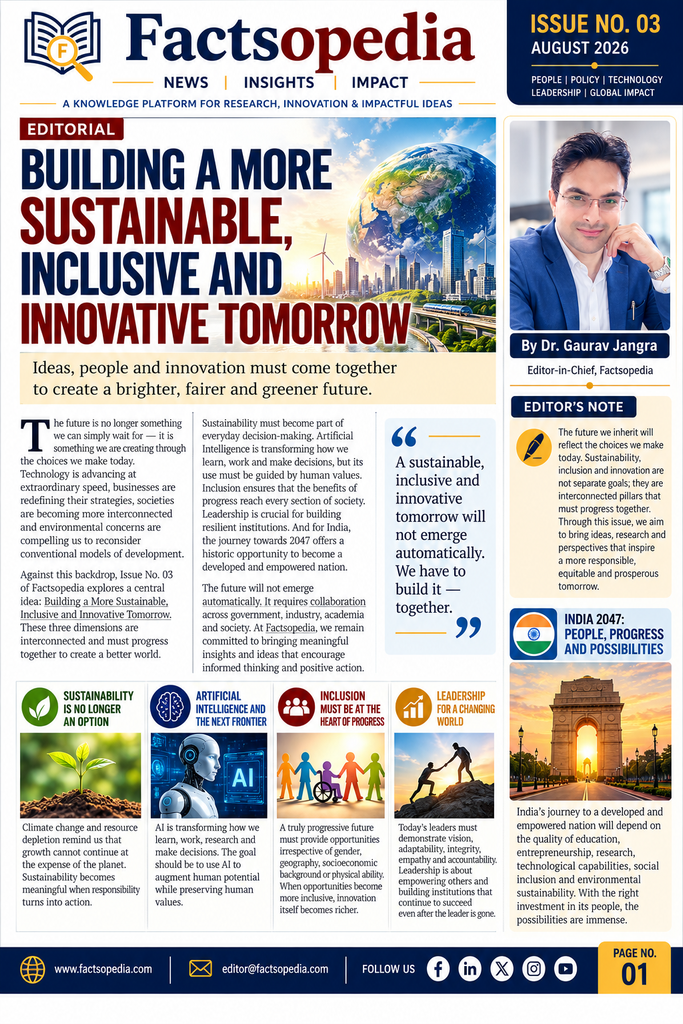
Editorial | Factsopedia – Issue No. 03, August 2026
By Dr. Gaurav Jangra
Editor-in-Chief, Factsopedia
The future is no longer something we can simply wait for—it is something we are creating through the choices we make today. Technology is advancing at extraordinary speed, businesses are redefining their strategies, societies are becoming more interconnected, and environmental concerns are compelling governments, institutions and individuals to reconsider conventional models of development. Against this backdrop, Issue No. 03 of Factsopedia explores a central idea: Building a More Sustainable, Inclusive and Innovative Tomorrow.
These three dimensions—sustainability, inclusion and innovation—should not be viewed independently. Sustainable progress without inclusion can widen inequalities. Inclusion without innovation may struggle to address emerging challenges. Innovation without responsibility can create consequences more serious than the problems it attempts to solve. The future therefore requires a balanced approach where people, technology, policy, leadership and the planet progress together.
Sustainability Is No Longer an Option
For decades, economic development was predominantly measured through production, consumption and financial growth. Today, our understanding of progress is becoming broader.
Climate change, resource depletion, pollution, waste generation and environmental degradation remind us that growth cannot continue indefinitely at the expense of the planet.
Sustainability must therefore move beyond corporate reports, policy documents and campaign slogans. It needs to become part of everyday decision-making.
Businesses must ask how they can create economic value while reducing their environmental footprint. Governments must develop policies that balance industrial growth with ecological responsibility. Educational institutions must prepare students to understand sustainability not merely as an environmental concept, but as an economic, managerial and social imperative.
And as individuals, we must recognise that millions of small choices collectively create enormous impact.
Sustainability becomes meaningful when responsibility turns into action.
Artificial Intelligence and the Next Frontier
No discussion about our future can ignore Artificial Intelligence.
AI is rapidly transforming how we learn, communicate, work, research, manufacture, market products and make decisions. Generative AI and increasingly capable AI systems are expanding the boundaries of what machines can accomplish.
This transformation presents extraordinary opportunities.
AI can support personalized education, improve healthcare systems, enhance business productivity, accelerate scientific discovery and help organizations make better decisions from complex data.
Yet technological capability alone cannot define progress.
As AI becomes more powerful, questions surrounding privacy, transparency, employment, bias, accountability and human oversight become equally important. The objective should not be to pursue automation simply because it is technologically possible.
The more important question is:
How can we use AI to augment human potential while preserving human values?
The future should not be framed merely as humans versus machines. A more productive vision is one in which technology complements human creativity, empathy, judgment and intelligence.
Inclusion Must Be at the Heart of Progress
Technological and economic advancement has little meaning if its benefits remain concentrated among a limited section of society.
A truly progressive future must provide opportunities irrespective of gender, geography, socioeconomic background or physical ability.
Digital transformation illustrates this challenge clearly. While millions enjoy instant access to information, online education, digital payments and AI-powered services, others continue to face barriers involving connectivity, affordability, digital literacy and access to quality education.
Closing these gaps should be central to development.
Inclusion is also about ensuring that diverse voices participate in decision-making. Women, young people, rural communities, marginalized groups and emerging entrepreneurs should not merely be beneficiaries of development; they should be active contributors to it.
When opportunities become more inclusive, innovation itself becomes richer.
Leadership for a Changing World
Institutions ultimately reflect the quality of their leadership.
The leadership models required for tomorrow will be different from those that worked in relatively stable environments. Today’s leaders operate amid technological disruption, geopolitical uncertainty, environmental challenges, rapidly changing consumer expectations and an increasingly informed society.
Leadership therefore cannot simply mean exercising authority.
Modern leadership requires vision, adaptability, integrity, empathy, accountability and the ability to empower others.
A successful leader does more than manage today’s performance. A successful leader builds institutions capable of succeeding even after that leader is gone.
Whether in education, business, government or civil society, we need leaders who can combine ambition with responsibility and innovation with ethical judgment.
India 2047: People, Progress and Possibilities
For India, these discussions carry particular significance as the country moves toward 2047, marking 100 years of independence.
India’s aspirations for becoming a developed and empowered nation will depend not only on economic indicators but also on the quality of education, employability of its youth, strength of institutions, technological capabilities, entrepreneurial ecosystem, social inclusion and environmental sustainability.
India possesses one of its greatest opportunities in its people.
A young population equipped with education, digital capabilities, entrepreneurial thinking, research orientation and future-ready skills can become an extraordinary force for development.
But demographic potential does not automatically become demographic advantage.
It requires investment in human capital.
Our universities must encourage research and innovation. Industries must create opportunities for skills and entrepreneurship. Policymakers must facilitate responsible growth. Researchers must convert knowledge into solutions. Businesses must pursue value creation beyond short-term profit.
Most importantly, young people must be encouraged not simply to search for opportunities, but also to create them.
From Information to Impact
This philosophy lies at the heart of Factsopedia.
The world already has an abundance of information. Every minute, enormous quantities of news, opinions, videos, posts and data compete for our attention.
What society increasingly needs is not simply more information, but meaningful information.
We need ideas that encourage people to think.
Insights that help people understand change.
Research that connects knowledge with real-world problems.
Stories that inspire action.
Perspectives that challenge conventional thinking.
And conversations that create impact.
That is why our identity—News | Insights | Impact—represents more than a tagline. It reflects the purpose we want Factsopedia to serve.
Through contributions from academicians, researchers, professionals, entrepreneurs, industry leaders and thoughtful citizens, we aim to build a multidisciplinary knowledge platform where ideas from education, technology, business, economy, society, policy, leadership, innovation, sustainability and other fields can reach a wider audience.
The Future Is a Shared Responsibility
No government, organization, technology or individual can build tomorrow alone.
The challenges confronting humanity are interconnected, and their solutions must therefore be collaborative.
Governments need industry. Industry needs academia. Academia needs society. Technology needs human judgment. Economic development needs environmental responsibility. And innovation needs ethics.
The future we eventually inherit will largely reflect the priorities we establish today.
As we present Issue No. 03 of Factsopedia, I invite our readers, contributors and professional community to look beyond immediate challenges and consider the larger possibilities ahead.
Let us build institutions that endure.
Let us develop technologies that empower.
Let us create businesses that generate responsible value.
Let us encourage leadership that inspires.
Let us pursue growth that includes everyone.
And let us leave behind a planet capable of supporting the generations that follow us.
Because a sustainable, inclusive and innovative tomorrow will not emerge automatically.
We have to build it—together.
Dr. Gaurav Jangra
Editor-in-Chief, Factsopedia
News | Insights | Impact
www.factsopedia.com