














Quiet Redesign of the Classroom – AI hasn’t replaced teachers and researchers — it has redrawn what they spend their time on. Here’s what that shift actually looks like, up close.
Sunday nights used to mean thirty essays and a red pen. Today, an AI tool drafts first-pass feedback in minutes, and the teacher spends that saved hour on the one student who actually needed her attention.
That shift is happening everywhere in education. Roughly six in ten U.S. teachers now use AI at work, nearly double last year’s rate. Most are using it for exactly what they are used to eating their evenings: proofreading, lesson plans, quizzes.
But readiness hasn’t kept pace. Seven in ten teachers say they don’t feel fully prepared to use these tools well, and nearly all want more support from school leaders. This isn’t resistance, it’s infrastructure moving faster than training.
WHERE IT’S WORKING
Feedback, fast. Draft-level grading now takes minutes, not weekends freeing teachers for the judgment calls no model can make, like telling genuine confusion from a bad week.
Real personalization. A class of thirty is thirty different starting points. AI can quietly adjust difficulty, surface targeted practice, and flag a struggling student weeks before a report card would the individualized-tutoring model researchers have chased for decades, now within reach, if unevenly so.
Research, compressed. Literature reviews that took a graduate student a month now take days. AI tools summarize published work and surface patterns across thousands of studies. The searching is being outsourced not the thinking which leaves more room for the thinking itself.
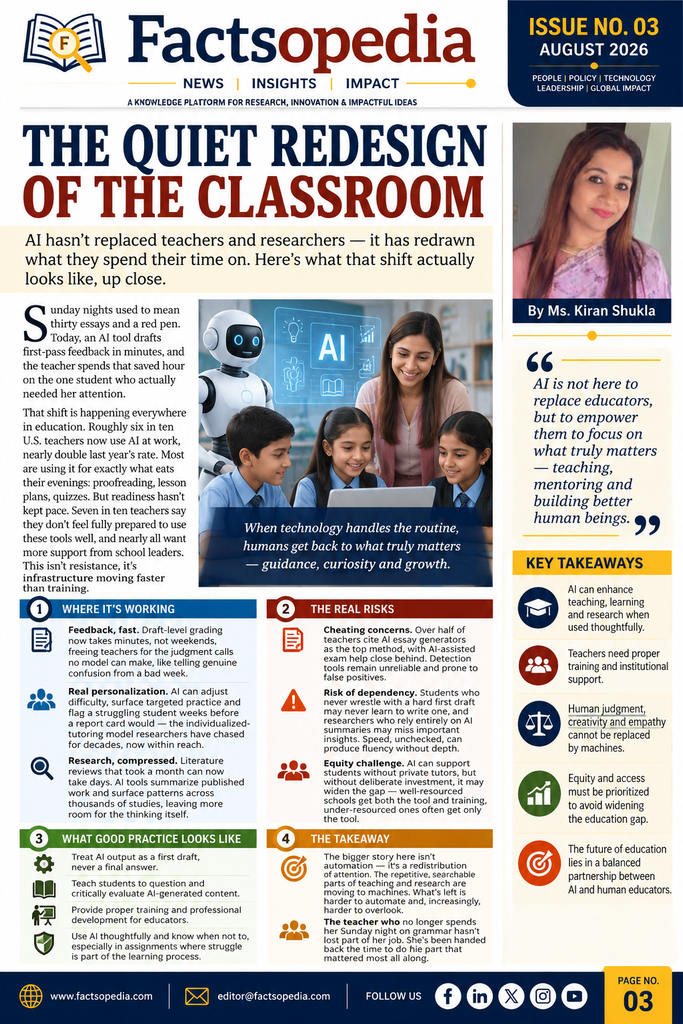
THE REAL RISKS
Cheating is the loudest concern, over half of teachers cite AI essay generators as the top method, with AI-assisted exam help close behind. Detection tools remain unreliable, prone to false positives that unfairly implicate honest students.
Quieter but deeper is the risk of dependency: a student who never wrestles with a hard first draft may never learn to write one, and a researcher who defers entirely to an AI summary may miss the outlier study that mattered most. Speed, unchecked, produces fluency without depth.
And equity cuts both ways. AI can hand a student without a private tutor the same quality of practice as one who has one. But without deliberate investment, it just as easily widens the gap well-resourced schools get both the tool and the training; under-resourced ones often get only the tool.
WHAT GOOD PRACTICE LOOKS LIKE
Institutions getting this right treat AI output as a first draft, never a final answer. Students are taught to question what a model produces, not submit it unexamined. Teachers are trained not just in how to use these tools, but when deliberately not to protect the assignments where struggle is the point.
Professional development matters more than any single tool. Handing a teacher an AI platform with no training is like handing someone a car with no driving lessons: functional, but far riskier than it needs to be.
THE TAKEAWAY
The bigger story here isn’t automation — it’s a redistribution of attention. The repetitive, searchable parts of teaching and research are moving to machines built for exactly that. What’s left is harder to automate and, increasingly, harder to overlook.
The teacher who no longer spends her Sunday night on grammar hasn’t lost part of her job. She’s been handed back the time to do the part that mattered most all along.