
Dr Simranjeet Singh, Assistant Professor, SVIET (Banur)
The Like Trap: Social Media and the Decline of Human Connection – There was a time when people used to share experiences, problems and pain with an impulse nature of helping others. If a fire broke out at any place, hands reached to carry water, ropes and other material to rescue strangers to safety. They were not supposed to wait for the ambulance or any other help from the government at that time; they just believed in their responsibility to save humanity. However, if we look at today’s environment, a terrifying transformation is taking place on our streets. We are witnessing a phenomenon where human suffering is treated not as an emergency to mitigate but as raw, not content to be captured to gain views and likes.
I will not be going to tell stories of ancient times but will take you to the incidents of June 2026. This problem became painfully visible during the Malviya Nagar building fire in South Delhi on June 3, 2026. A massive fire tore through a commercial building, taking at least 21 lives. Reports and videos from the scene showed terrified people trapped inside, calling for help and trying to survive smoke. Another painful example was the Lucknow, Uttar Pradesh, coaching centre fire on 22 June 2026, where a massive fire broke out inside a commercial building in Aliganj that housed an animation and training centre. At least 15 students lost their lives, while many others are injured and mentally terrified with the scene. Do you remember the Mumbai local train incident? that took place on 23 June 2026, where a 22-year-old boy, Mayank Lohar, was murdered in a crowded local train in Mumbai, but no one came forward to protect him or to stop the conflict.
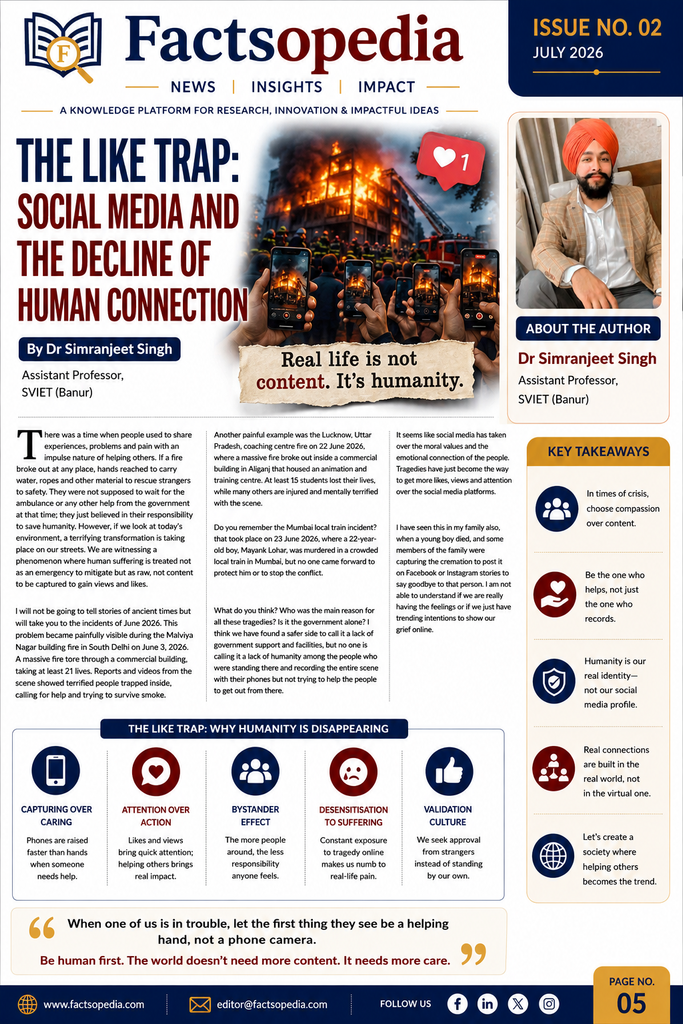
What do you think? Who was the main reason for all these tragedies? Is it the government alone? I think we have found a safer side to call it a lack of government support and facilities, but no one is calling it a lack of humanity among the people who were standing there and recording the entire scene with their phones but not trying to help the people to get out from there. It seems like social media has taken over the moral values and the emotional connection of the people. Tragedies have just become the way to get more likes, views and attention over the social media platforms.
I have seen this in my family also, when a young boy died, and some members of the family were capturing the cremation to post it on Facebook or Instagram stories to say goodbye to that person. I am not able to understand if we are really having the feelings or if we just have trending intentions to show our grief online. Whether you agree or not, one thing is clear: when one of us will be in the same situation, expect that the first thing we will see from the people surrounding us will be their mobile phone camera, not the first aid.
We need to understand that technology itself is not the problem; phones are not the problem; the real problem is our desire to gain short-term attention on a 5-inch screen (mobiles). Humanity is measured in the moments of crises; just posting good reels and saying good words on camera is not enough. Our real character is based on how we act toward situations. Likes disappear, views stop reaching new audiences, and trends fade, but the families who lost their children, friends and loved ones will witness the pain and suffering throughout their lives. It is up to us whether to value attention more than humanity, reel more than a help, or follow more than a dying kid.