













By Dr. Sachin Sudan
Associate Professor, MM Institute of Management, MM (Deemed to be University), Mullana, India
Introduction
For decades, India’s middle class believed in a powerful promise: hard work and academic excellence could transform lives. Competitive examinations such as NEET, IIT-JEE, UPSC, and other national-level tests became symbols of opportunity, offering students a chance to overcome social and economic barriers through merit. Success in these examinations represented not only personal achievement but also a pathway toward upward social mobility.
However, recent years have witnessed growing concerns regarding the credibility of competitive examinations in India. Repeated paper leak scandals, examination cancellations, administrative failures, and allegations of systemic irregularities have shaken public confidence. For millions of students and their families, the dream of merit-based success appears increasingly fragile.
The Foundation of India’s Meritocratic Dream
India’s education system has long been built around the belief that talent and hard work can create opportunities regardless of background. Competitive examinations were designed to identify capable candidates and allocate limited educational and professional opportunities fairly.
For generations of middle-class families, education served as the most reliable route to economic security and social advancement. Parents invested their savings, aspirations, and hopes into their children’s academic journeys, believing that merit would ultimately be rewarded.
Today, that belief is being tested.
The Supply-Demand Crisis in Higher Education
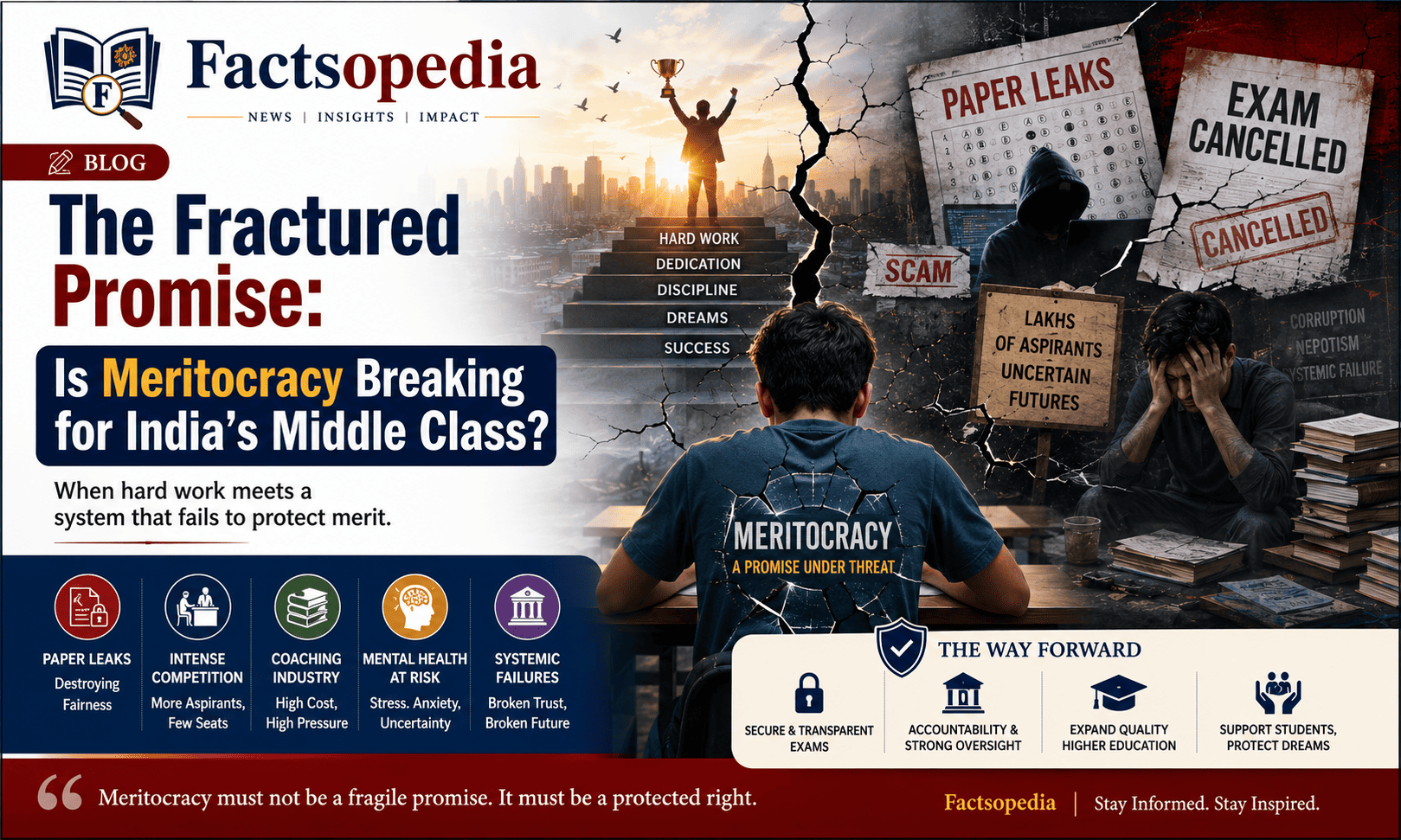
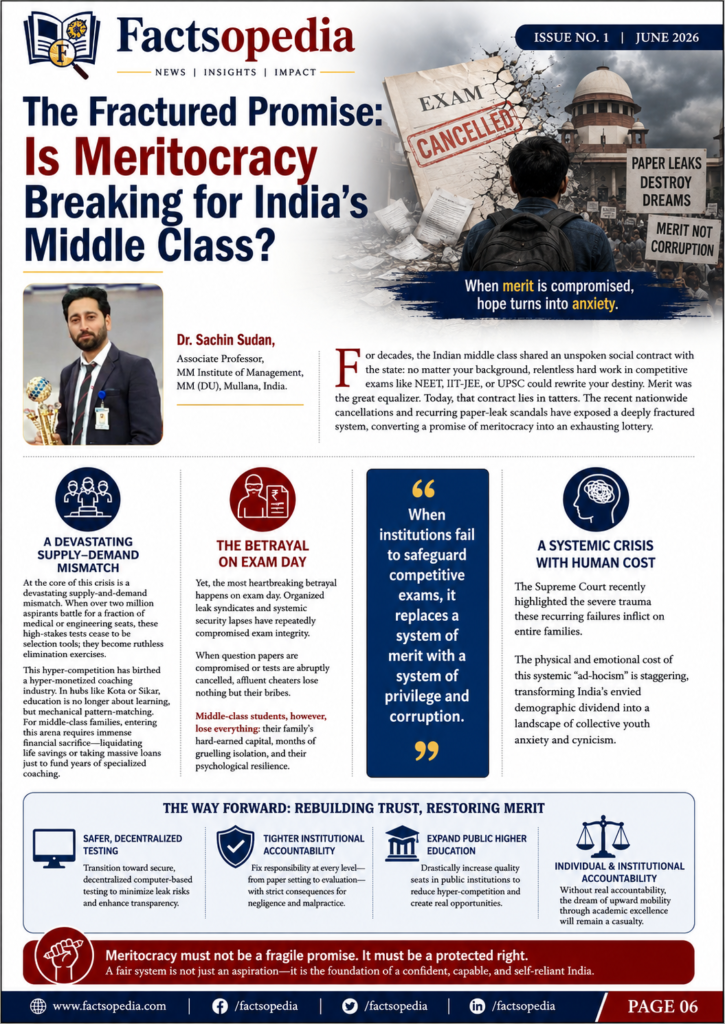
One of the biggest challenges facing India’s examination system is the enormous mismatch between demand and available opportunities.
Every year, millions of students compete for a relatively limited number of seats in prestigious institutions and professional programs. For example:
- Millions appear for engineering and medical entrance examinations.
- Only a fraction secure admission to top institutions.
- Competition has reached unprecedented levels.
In such an environment, examinations often function less as talent-identification mechanisms and more as elimination processes. The intense pressure creates enormous stress for students and families alike.
The Rise of the Coaching Economy
Hyper-competition has fueled the growth of a massive coaching industry across India. Cities such as Kota, Sikar, Hyderabad, and Delhi have become educational hubs where students spend years preparing for highly competitive examinations.
While coaching institutions provide valuable support for many students, the commercialization of exam preparation has also raised concerns:
- Rising educational expenses.
- Increasing dependence on coaching.
- Reduced focus on conceptual learning.
- Mental health challenges among students.
- Inequality between students with varying financial resources.
For many middle-class families, funding coaching programs requires substantial financial sacrifices, often involving loans, depleted savings, and years of economic planning.
When Merit Meets Systemic Failure
The most damaging aspect of the current crisis emerges when examination integrity itself is compromised.
Paper leaks, cheating networks, administrative lapses, and last-minute cancellations undermine the credibility of the entire selection process. Students who have invested years of effort suddenly face uncertainty through no fault of their own.
When examination systems fail:
- Honest students lose confidence.
- Families experience emotional and financial distress.
- Public trust in institutions declines.
- Perceptions of fairness are weakened.
Meritocracy depends not only on hard work but also on trust in the institutions responsible for evaluating merit.
The Psychological Cost of Examination Uncertainty
The consequences of examination failures extend far beyond academic outcomes.
Students often devote months or years preparing for high-stakes examinations. Unexpected cancellations, repeated rescheduling, or allegations of malpractice can result in:
- Anxiety and stress.
- Emotional exhaustion.
- Loss of motivation.
- Mental health concerns.
- Career uncertainty.
The burden is shared by families who invest significant emotional and financial resources in their children’s aspirations.
The growing sense of uncertainty has created widespread concern regarding the future of India’s youth and the sustainability of its educational aspirations.
The Need for Structural Reforms
Addressing these challenges requires comprehensive reforms rather than temporary solutions.
Strengthening Examination Security
Technology-driven monitoring systems, secure digital infrastructure, and improved oversight mechanisms can reduce the risk of leaks and malpractice.
Expanding Computer-Based Testing
Decentralized computer-based testing models can improve security, flexibility, and transparency while minimizing logistical vulnerabilities.
Institutional Accountability
Educational and examination authorities must establish clear accountability frameworks with strict consequences for negligence, misconduct, and administrative failures.
Expanding Higher Education Capacity
Increasing the number of quality institutions and available seats can reduce excessive competition and create broader opportunities for students.
Supporting Student Well-Being
Mental health support systems, counseling services, and stress-management programs should become integral components of educational ecosystems.
Rebuilding Trust in Meritocracy
Meritocracy remains one of the most powerful ideas in a democratic society. It offers individuals hope that effort, talent, and dedication can shape their future regardless of their background.
However, meritocracy can only function when institutions are transparent, trustworthy, and fair.
Rebuilding confidence requires consistent reforms, stronger governance, and a commitment to protecting the aspirations of millions of students who place their faith in the education system.
Conclusion
India’s demographic advantage depends heavily on the potential of its young population. Competitive examinations play a critical role in shaping educational and professional opportunities, making their integrity essential for social and economic progress.
The recent challenges surrounding examination systems should serve as a wake-up call for policymakers, institutions, and society as a whole. Ensuring fairness, transparency, and accountability is not merely an administrative responsibility—it is a national priority.
The promise of meritocracy must remain a protected right rather than a fragile hope. Only then can India’s middle class continue to believe that hard work and talent are sufficient to build a better future.
Factsopedia – News | Insights | Impact