














Prof. (Dr.) Ajai Pal Sharma
It is universally true that strong institutions are needed to build a strong nation, but some issues, whether to create new institutions or to strengthen the existing ones, remain unresolved. I am of the strong opinion that second be given priority. Leadership and institution building are fundamental pillars that determine the sustainability, impact, and resilience of any organisation, whether academic or corporate. While leadership often focuses on vision, strategy, and guiding individuals toward shared goals, institution building translates that strategic vision into durable structures, culture, and processes. Above all, institution building is the creation of governance capacities, increasing the efficiency of existing institutions, and enhancing professionalism. But many of the institutions lack on this front, and the education sector is not excluded.
The education sector, which was considered a service to the nation, has become the most attractive business. Today, all kinds of institutions can be found operating and providing education, from primary to the award of PhDs. But the essential facilities/infrastructure required for such education are found missing. The responsibility and accountability for this lie with the related governing bodies that provide them the license to do so. Even ghost-writers are writing PhD theses, and the same are being awarded successfully by various universities. This may be one of the reasons leading to the degradation of the quality of education, and we are unable to find a place in the top 200 educational institutions of the world. If we have to show our presence at global level, this needs to be checked at the earliest.
For me, education leadership is not so simple. It requires a lot of caring, sharing, elevating, and motivating all stakeholders. Moreover, it’s distinct from political or behavioural leadership. Institution building is not as simple as it looks, but one of the most difficult tasks for any academic leader. It may not be possible for everyone to build an institution, as it requires specific creative skills, commitment, sacrifice, dedication, honesty and a visionary approach. It is equally true that there is no dearth of such effective leaders, but difficult to find a combination of all the above-mentioned qualities in one person.
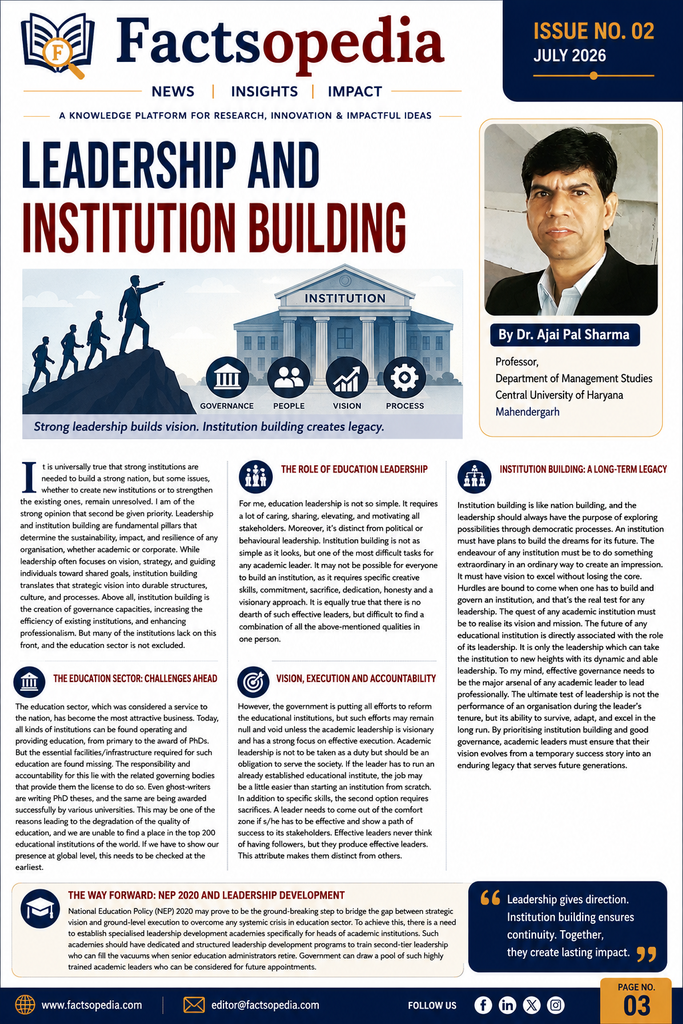
However, the government is putting all efforts to reform the educational institutions, but such efforts may remain null and void unless the academic leadership is visionary and has a strong focus on effective execution. Academic leadership is not to be taken as a duty but should be an obligation to serve the society. If the leader has to run an already established educational institute, the job may be a little easier than starting an institution from scratch. In addition to specific skills, the second option requires sacrifices. A leader needs to come out of the comfort zone if s/he has to be effective and show a path of success to its stakeholders. Effective leaders never think of having followers, but they produce effective leaders. This attribute makes them distinct from others.
Institution building is like nation building, and the leadership should always have the purpose of exploring possibilities through democratic processes. An institution must have plans to build the dreams for its future. The endeavour of any institution must be to do something extraordinary in an ordinary way to create an impression. It must have vision to excel without losing the core. Hurdles are bound to come when one has to build and govern an institution, and that’s the real test for any leadership. The quest of any academic institution must be to realise its vision and mission. The future of any educational institution is directly associated with the role of its leadership. It is only the leadership which can take the institution to new heights with its dynamic and able leadership. To my mind, effective governance needs to be the major arsenal of any academic leader to lead professionally. The ultimate test of leadership is not the performance of an organisation during the leader’s tenure, but its ability to survive, adapt, and excel in the long run. By prioritising institution building and good governance, academic leaders must ensure that their vision evolves from a temporary success story into an enduring legacy that serves future generations.
National Education Policy (NEP) 2020 may prove to be the ground-breaking step to bridge the gap between strategic vision and ground-level execution to overcome any systemic crisis in education sector. To achieve this, there is a need to establish specialised leadership development academies specifically for heads of academic institutions. Such academies should have dedicated and structured leadership development programs to train second-tier leadership who can fill the vacuums when senior education administrators retire. Government can draw a pool of such highly trained academic leaders who can be considered for future appointments.
Dr. Ajai Pal Sharma
Professor,
Department of Management Studies
Central University of Haryana