

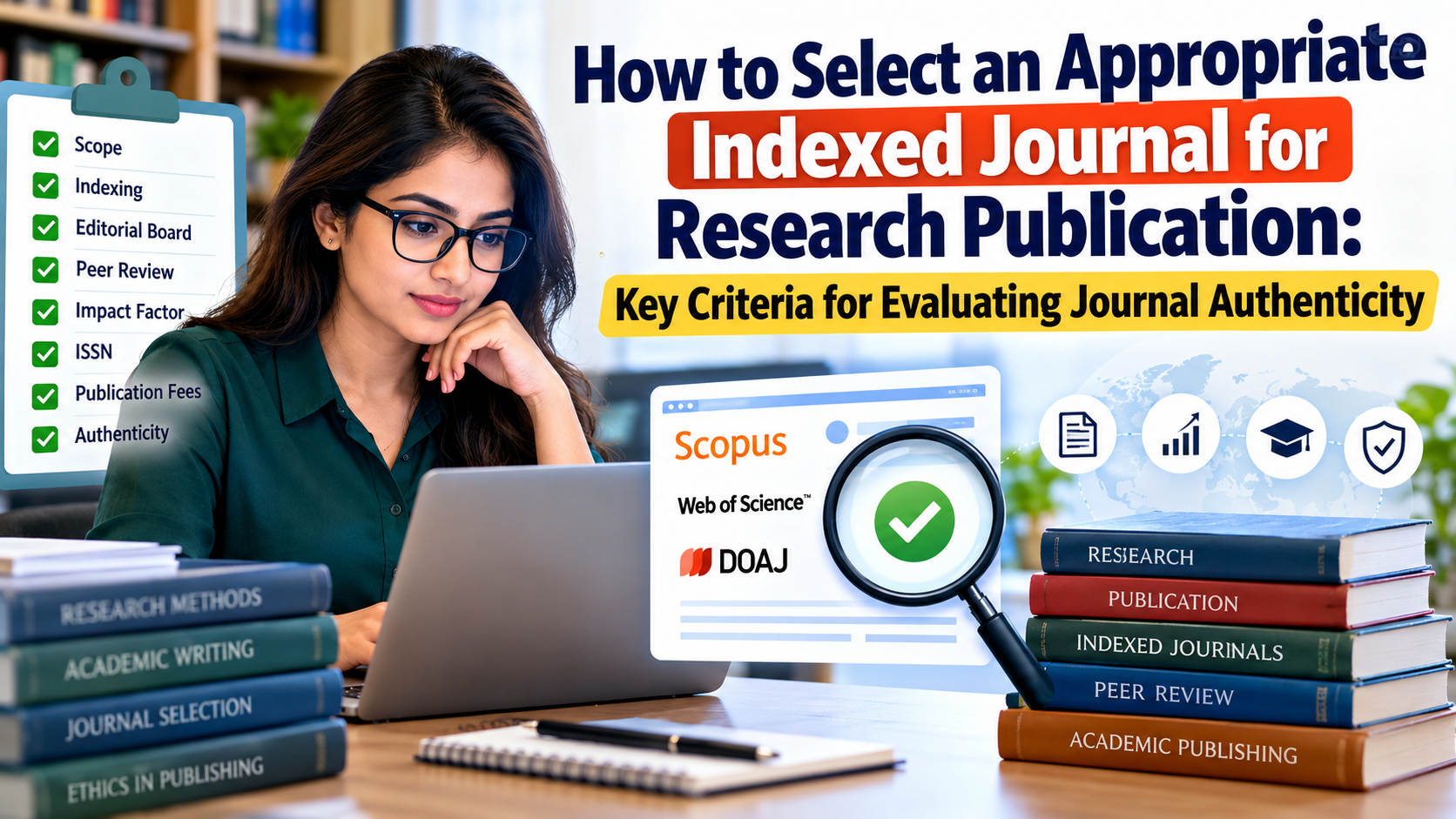

Learn how to select an appropriate indexed journal for research publication. Check Scopus, Web of Science, peer review, ISSN, editorial board, publication fees, journal authenticity, and warning signs of predatory journals before submitting your research paper. | indexed journal selection, journal authenticity check, Scopus indexed journals, Web of Science journals, predatory journals, research paper publication, journal indexing verification, authentic research journals, journal selection criteria, academic publishing
Dr. Gaurav Jangra | Issue 4 | September 2026 | Editorial Article
Introduction
Publishing a research article in a reputable journal is an important milestone for researchers, academicians, doctoral scholars, and postgraduate students. However, selecting the right journal has become increasingly challenging because thousands of journals are available across different disciplines, publishers, databases, and publishing models.
Therefore, understanding how to select an appropriate indexed journal for research publication and the key criteria for evaluating journal authenticity is essential before submitting a manuscript.
A poor journal choice can result in repeated rejection, unnecessary publication fees, limited visibility, delayed publication, or, in the worst case, publication in a predatory or deceptive journal. Researchers should consequently evaluate not only whether a journal claims to be indexed but also whether its indexing status, editorial practices, peer-review process, publisher credentials, publication ethics, and journal metrics are genuine.
This guide from Factsopedia Magazine explains the major factors researchers should examine before submitting their research articles.
1. Match the Journal’s Aim and Scope with Your Research
The first step in journal selection is checking whether your research article fits the aims and scope of the journal.
Every legitimate academic journal defines the subjects, disciplines, methodologies, research areas, and types of manuscripts it publishes.
For example, a manuscript examining artificial intelligence applications in consumer behaviour may be appropriate for journals covering:
- Digital marketing
- Consumer behaviour
- Artificial intelligence in business
- Marketing analytics
- Information systems
- Technology adoption
Submitting an article outside the journal’s scope considerably increases the possibility of desk rejection.
Before submission, researchers should read the journal’s aims and scope and review approximately 5–10 recently published papers. This provides a practical indication of whether the manuscript is aligned with the journal.
Ask yourself:
- Does the journal regularly publish articles related to my research topic?
- Does my methodology fit the journal’s usual research approach?
- Is my target population relevant to the journal’s readership?
- Have similar studies appeared in the journal recently?
A strong thematic match improves both editorial interest and the probability that the article will reach the appropriate academic audience.
2. Verify the Journal’s Indexing Status
One of the most important steps before manuscript submission is independently verifying the journal’s indexing.
Researchers commonly look for journals indexed in databases such as:
- Scopus
- Web of Science Core Collection
- Science Citation Index Expanded (SCIE)
- Social Sciences Citation Index (SSCI)
- Arts & Humanities Citation Index (AHCI)
- Emerging Sources Citation Index (ESCI)
- Directory of Open Access Journals (DOAJ)
- Discipline-specific scholarly databases
Never rely only on an indexing logo displayed on a journal’s website.
How to Check Scopus Indexing
If a journal claims that it is indexed in Scopus, search for the journal directly through the official Scopus Sources information or Scopus title list.
Elsevier states that researchers can check whether a title is included in Scopus through its freely accessible source information and title lists. Scopus also continually re-evaluates journals, and titles may be discontinued when publication standards or research-integrity concerns arise.
When verifying a Scopus journal, check:
- Exact journal title
- ISSN/eISSN
- Publisher
- Subject category
- Coverage years
- Current or discontinued status
This last point is particularly important. A journal might have articles indexed in Scopus from previous years while no longer having active Scopus coverage.
How to Check Web of Science Indexing
For journals claiming Web of Science indexing, researchers should use the official Clarivate Master Journal List.
Clarivate describes its Master Journal List as the authoritative source for determining Web of Science journal coverage. Journals included in major Web of Science Core Collection indexes undergo editorial evaluation.
Check whether the journal belongs to:
- SCIE
- SSCI
- AHCI
- ESCI
Do not assume that the phrase “Web of Science indexed” automatically means that a journal has a Journal Impact Factor or belongs to SCIE or SSCI.
3. Check the ISSN and eISSN
A legitimate serial journal generally has an International Standard Serial Number (ISSN).
Print and online versions may have separate numbers:
ISSN: for the print version
eISSN: for the electronic version
Researchers should verify whether the ISSN displayed on the journal’s website corresponds to the same journal title and publisher.
Be cautious when:
- No ISSN is provided.
- The ISSN belongs to another publication.
- The journal title differs from the registered title.
- Publisher information is inconsistent across websites.
An ISSN alone, however, does not guarantee journal quality or indexing. It only identifies a serial publication.
4. Investigate the Publisher
Before submitting a manuscript, investigate the organisation publishing the journal.
Check whether the publisher has:
- A clearly identifiable organisation
- An official website
- Verifiable contact information
- A physical or institutional address
- A transparent publication history
- Multiple established journals where applicable
- Clear editorial and ethical policies
Suspicious publishers often provide incomplete contact information, generic email addresses, questionable addresses, or websites containing misleading claims.
The Think. Check. Submit. initiative specifically recommends evaluating whether researchers recognise the journal or publisher, whether contact details can be verified, and whether the publication practices appear transparent before submission.
5. Examine the Editorial Board
A genuine scholarly journal normally provides detailed information about its editorial structure.
Look for:
- Editor-in-Chief
- Associate Editors
- Editorial Board Members
- Institutional affiliations
- Academic credentials
- Country or university details
DOAJ’s quality criteria, for example, require open-access journals applying for inclusion to clearly identify their editor and editorial board, including the names and affiliations of editorial members.
Warning Signs
Be cautious if:
- Editorial board members have no affiliations.
- Members appear unrelated to the journal’s discipline.
- The same few individuals control many unrelated journals.
- Academic profiles of editors cannot be verified.
- Researchers appear on the editorial board without their knowledge.
- No Editor-in-Chief is identified.
Researchers can verify editorial members through university websites, ORCID profiles, Google Scholar, institutional profiles, or other academic databases.
6. Understand the Journal’s Peer-Review Process
Peer review is one of the fundamental mechanisms of scholarly quality control.
An authentic journal should clearly explain:
- Whether it uses single-blind, double-blind, open, or another review model
- How reviewers are selected
- How many reviewers normally evaluate a paper
- Editorial decision procedures
- Revision requirements
- Conflict-of-interest policies
DOAJ’s criteria require journals seeking inclusion to state their quality-control or peer-review process clearly.
Be Suspicious of Unrealistically Fast Acceptance
Statements such as:
“Submit today and receive acceptance within 24 hours”
should be treated cautiously.
A rapid initial editorial screening is possible, but meaningful scholarly peer review normally requires enough time for subject experts to evaluate the manuscript, methodology, interpretation, originality, references, and contribution.
A journal guaranteeing acceptance even before reviewing the manuscript is a major warning sign.
7. Verify Journal Metrics Instead of Trusting Website Claims
Researchers frequently select journals based on metrics. Unfortunately, misleading journals may advertise fabricated or unofficial “impact factors.”
Common legitimate indicators can include:
- Journal Impact Factor
- Journal Citation Indicator
- CiteScore
- SCImago Journal Rank
- Source Normalized Impact per Paper
- Quartile ranking
However, different metrics are produced by different databases and should not be treated as interchangeable.
For example, researchers should distinguish between:
Journal Impact Factor – associated with Clarivate’s Journal Citation Reports
and
CiteScore – derived from Scopus data.
Do not assume that any number labelled “Global Impact Factor,” “Universal Impact Factor,” “International Impact Factor,” or a similarly impressive-sounding metric has the same status as established citation indicators.
Always verify the metric through the organisation responsible for producing it.
8. Check the Journal’s Publication History
Examine several recent issues of the journal.
Look for:
- Regular publication schedule
- Consistent volume and issue numbering
- Articles relevant to the journal’s scope
- Reasonable publication frequency
- Complete author affiliations
- DOI information
- References
- Submission and acceptance dates where available
- Professional article formatting
Scopus considers publishing regularity and online availability among its journal evaluation criteria.
A sudden publication of hundreds of unrelated articles within a short period may deserve additional investigation, particularly if the journal previously published substantially fewer papers.
9. Check DOI Registration
Most established scholarly journals assign Digital Object Identifiers (DOIs) to published articles.
A DOI helps provide persistent identification and linking for scholarly documents.
Researchers should test DOI links from previously published articles.
Verify that:
- DOI links are functional.
- They resolve to the correct article.
- Article metadata matches the journal.
- Author details are accurate.
Remember that having a DOI does not itself establish that a journal is authentic. Questionable journals can also obtain DOIs. It should therefore be considered only one part of the authenticity assessment.
10. Carefully Examine Article Processing Charges
Open-access publishing may legitimately involve an Article Processing Charge (APC).
Charging a publication fee does not automatically make a journal predatory.
A reputable journal should clearly state:
- APC amount
- Currency
- Applicable taxes
- Waiver policy
- When payment becomes due
- What the charge covers
Researchers should become cautious when fees are hidden until acceptance or when payment appears to be the primary criterion for publication.
Also remember:
High APC ≠ High Quality
and
No APC ≠ Low Quality
Journal quality should be evaluated primarily through editorial standards, peer review, indexing, transparency, scholarly reputation, and research integrity.
11. Check Publication Ethics Policies
Authentic scholarly journals should maintain clear policies relating to research and publication ethics.
Look for policies covering:
- Plagiarism
- Duplicate publication
- Retractions
- Corrections
- Authorship
- Conflicts of interest
- Data fabrication
- Research misconduct
- Human-participant ethics
- Artificial intelligence use, where applicable
- Copyright and licensing
Researchers may also examine whether the journal or publisher follows recognised scholarly publishing principles or relevant professional organisations.
Transparency regarding ethical practices is a strong indicator of responsible journal management.
12. Check Whether the Journal Is Listed in DOAJ for Open-Access Publishing
For open-access journals, the Directory of Open Access Journals (DOAJ) can be another useful verification source.
DOAJ maintains criteria covering transparency, peer review, editorial boards, licensing, copyright, websites, and journal management.
However, researchers should understand that:
Not being listed in DOAJ does not automatically mean a journal is predatory.
Similarly, DOAJ should not replace Scopus or Web of Science verification when a university or funding organisation specifically requires those databases.
13. Analyse the Journal’s Previously Published Articles
Reading published articles is one of the easiest but most overlooked journal-evaluation methods.
Evaluate:
- Research quality
- Methodological rigour
- Writing quality
- Reference quality
- Relevance to journal scope
- Author diversity
- Institutional representation
- Citation patterns
If recently published papers contain obvious grammatical problems, weak methodologies, irrelevant topics, questionable citations, or poor formatting, researchers should investigate further before submitting.
14. Search for Journal Reputation and Retraction Concerns
Search the journal title, publisher name, and Editor-in-Chief independently.
You may search combinations such as:
“[Journal Name] review”
“[Journal Name] predatory”
“[Journal Name] discontinued Scopus”
“[Publisher Name] publication ethics”
“[Journal Name] retraction”
However, online accusations should not automatically be treated as proof. Evaluate evidence from recognised indexing databases, institutions, scholarly publishing organisations, and official notices.
15. Beware of Look-Alike or Hijacked Journals
One serious risk researchers should recognise is the hijacked journal.
In this type of fraud, a fake website imitates the name of a genuine academic journal and may copy:
- Journal title
- ISSN
- Editorial information
- Logos
- Indexing claims
Researchers may unknowingly submit manuscripts and payments to the fraudulent website.
Therefore, compare:
- Official publisher website
- ISSN details
- Scopus or Web of Science source information
- Journal URL
- Publisher details
Do not reach a journal only through an unsolicited email link.
16. Examine Unsolicited Publication Emails Carefully
Researchers frequently receive messages inviting them to submit papers.
An invitation itself does not prove that the journal is predatory. However, suspicious messages commonly:
- Use excessive praise.
- Claim your previous paper is “excellent” without discussing it meaningfully.
- Promise guaranteed acceptance.
- Request manuscripts unrelated to the journal’s scope.
- Offer extremely rapid publication.
- Use generic email accounts.
- Contain poor grammar.
- Repeatedly demand publication fees.
Always locate and verify the journal independently rather than clicking the submission link provided in such an email.
17. Check Journal Turnaround Time Realistically
Researchers naturally want faster publication, particularly when facing:
- Thesis submission deadlines
- Promotions
- Grant requirements
- Academic appointments
- Project completion
- Institutional requirements
However, speed should not replace credibility.
Instead of searching for “fast publication journals,” researchers should search for journals that offer:
transparent and efficient peer review.
Some high-quality journals make rapid decisions, but credible journals generally do not guarantee acceptance.
18. Consider Journal Quartile and Reputation
Depending on institutional or career requirements, researchers may also examine journal ranking.
Scopus-associated journal rankings are often grouped as:
- Q1
- Q2
- Q3
- Q4
Q1 journals generally represent the upper segment within a particular category according to the ranking methodology being used.
However, journal quartile should not be the only selection criterion.
A highly ranked journal that does not fit your research topic may be less appropriate than a specialised journal that directly reaches your intended scholarly audience.
The best journal represents a balance among:
Scope + Quality + Indexing + Audience + Reputation + Publication Probability
19. Review Author Guidelines Before Submission
Before formatting your research article, carefully examine the journal’s Instructions for Authors.
Check:
- Word limit
- Abstract format
- Reference style
- Manuscript structure
- Figure requirements
- Table formatting
- Supplementary files
- Ethical declarations
- Conflict-of-interest statements
- Data-availability statements
- AI-use declarations where required
- Cover letter requirements
Failure to follow author guidelines can result in editorial delays or desk rejection even when the underlying research is strong.
20. Never Submit the Same Manuscript to Multiple Journals Simultaneously
Researchers may sometimes submit the same article to multiple journals hoping to obtain quicker acceptance.
This practice is generally considered unethical unless explicitly allowed under a particular publishing model.
Submit the manuscript to one journal and wait for:
- Acceptance,
- Rejection, or
- Formal withdrawal
before submitting it elsewhere.
Following publication ethics protects both the researcher and the integrity of scholarly communication.
Journal Authenticity Checklist Before Submission
Before clicking Submit, verify the following:
| Check | What to Verify |
|---|---|
| Journal Scope | Your manuscript matches the aims and scope |
| Scopus Status | Verify through official Scopus Sources/title list |
| Web of Science | Verify through Clarivate Master Journal List |
| ISSN/eISSN | Match title and publisher information |
| Publisher | Genuine organisation and verifiable contact details |
| Editorial Board | Recognised academics with institutional affiliations |
| Peer Review | Clearly explained and academically reasonable |
| Publication History | Regular issues and relevant research articles |
| DOI | Previous article DOIs resolve correctly |
| APC | Fees clearly disclosed |
| Ethics Policy | Plagiarism, retraction and authorship policies available |
| Metrics | Verify through the original metric provider |
| Journal Website | Professional, consistent and transparent |
| Author Guidelines | Complete submission instructions available |
| Acceptance Claims | No guaranteed publication promises |
| Contact Email | Preferably institutional or publisher-domain email |
| Published Articles | Demonstrate reasonable academic quality |
| Indexing Logo | Independently verify instead of trusting the logo |
| Discontinued Status | Check whether current indexing remains active |
| Reputation | Search independent scholarly sources |
Red Flags of a Potential Predatory Journal
Researchers should investigate further when several of the following warning signs appear together:
- Guaranteed acceptance
- Publication within one or two days
- Fake or unverifiable indexing claims
- Misleading impact-factor terminology
- Hidden publication charges
- Extremely broad or unrelated journal scope
- Unknown or fabricated editorial members
- Poorly written journal website
- Repeated unsolicited emails
- Fake conference-journal publication packages
- Unverifiable publisher address
- Journal title designed to resemble a famous journal
- No clear peer-review policy
- Unprofessional submission through personal email accounts
- Hundreds of unrelated papers published unusually quickly
No single sign always proves that a journal is predatory. Researchers should assess the overall pattern of transparency, credibility, indexing, editorial quality, and publishing behaviour.
A Simple Formula for Selecting the Right Research Journal
Researchers can remember the following:
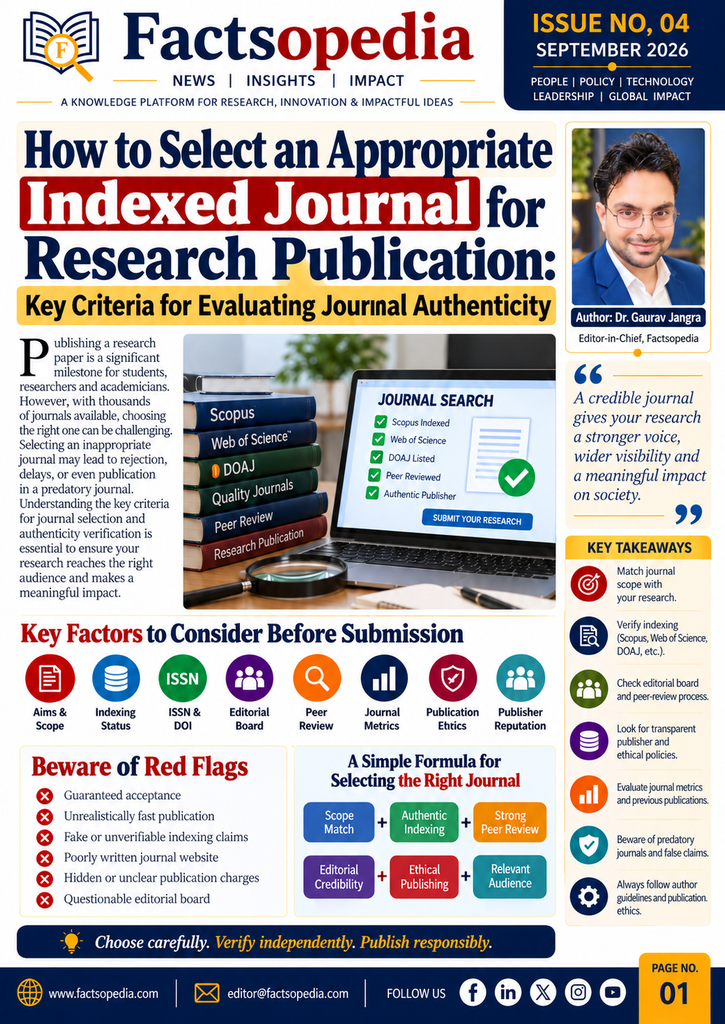
Right Journal = Scope Match + Authentic Indexing + Strong Peer Review + Editorial Credibility + Ethical Publishing + Relevant Audience
Indexing alone should never be the sole criterion.
A journal may be indexed but still be a poor fit for your research. Similarly, a genuine new or specialised journal may not yet be included in major citation databases.
The final decision should depend on your research objective, target audience, institutional requirements, subject area, and desired scholarly impact.
Frequently Asked Questions
How can I check whether a journal is genuinely Scopus indexed?
Search the exact journal title or ISSN through the official Scopus source information rather than relying on claims made on the journal website. Also examine current coverage and whether the source has been discontinued.
How can I verify Web of Science indexing?
Use Clarivate’s official Master Journal List and search by journal title or ISSN. The Master Journal List is Clarivate’s authoritative source for Web of Science coverage.
Does an ISSN prove that a journal is genuine?
No. An ISSN identifies a serial publication but does not automatically prove scholarly quality, peer-review standards, or indexing.
Is every paid journal predatory?
No. Many reputable open-access journals charge legitimate article processing charges. The important factors are transparency, editorial quality, peer review, ethics, indexing, and publisher credibility.
Is every free journal genuine?
No. A journal cannot be considered genuine merely because it does not charge publication fees.
Is Google Scholar indexing enough?
Google Scholar visibility is useful for discovering scholarly material, but researchers should not treat it as equivalent to selective indexing systems such as Scopus or the Web of Science Core Collection.
What is the best way to avoid predatory journals?
Use independent verification. A useful principle is Think, Check, and then Submit. The Think. Check. Submit. initiative recommends completing journal credibility checks before manuscript submission.
Conclusion
Understanding how to select an appropriate indexed journal for research publication and the key criteria for evaluating journal authenticity is now an essential research skill.
Researchers should never choose a journal simply because it promises rapid publication, displays attractive indexing logos, claims a high impact factor, or sends an impressive submission invitation.
Before submitting your manuscript, independently verify the journal’s indexing status, ISSN, publisher, editorial board, peer-review process, publication ethics, metrics, article quality, publication charges, and previous publication history.
Most importantly, use the official databases themselves when verifying indexing claims.
A few minutes spent checking journal authenticity can protect months or even years of research effort.
Choose carefully. Verify independently. Publish responsibly.