














Dr. Kamal Dhanda, Associate Professor, Chitkara University
Artificial Intelligence (AI) has evolved rapidly—from rule-based systems and machine learning to deep learning and Generative AI. Conversational AI and Large Language Models (LLMs) have made it possible to communicate with computers using natural language. Today, AI can write articles, generate code, summarize documents, analyze information, and answer complex questions. However, the next major step is the emergence of AI agents, which are designed not only to respond but also to understand goals, plan tasks, use tools, and take action.
From Chatbots to AI Agents
A traditional chatbot generally follows a simple question → response model. An AI agent goes beyond this approach by pursuing a specific objective through multiple steps. For example, if asked to “prepare a report on recent AI developments,” an agent could search for relevant information, collect sources, compare findings, organize the content, generate the report, and review the result. Thus, while a chatbot primarily answers, an AI agent is designed to achieve a goal.
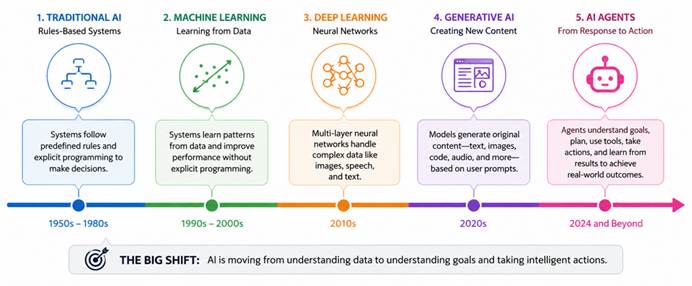
Figure 1: Evolution of Artificial Intelligence
How Does an AI Agent Work?
An AI agent combines reasoning, planning, memory, external tools, and feedback. The LLM provides language and reasoning capabilities, while tools such as search engines, databases, APIs, software applications, and code-execution environments allow the agent to interact with the world. The agent understands the objective, creates a plan, selects appropriate tools, performs actions, observes the results, and evaluates whether the goal has been achieved. If necessary, it can revise its approach and continue the process.
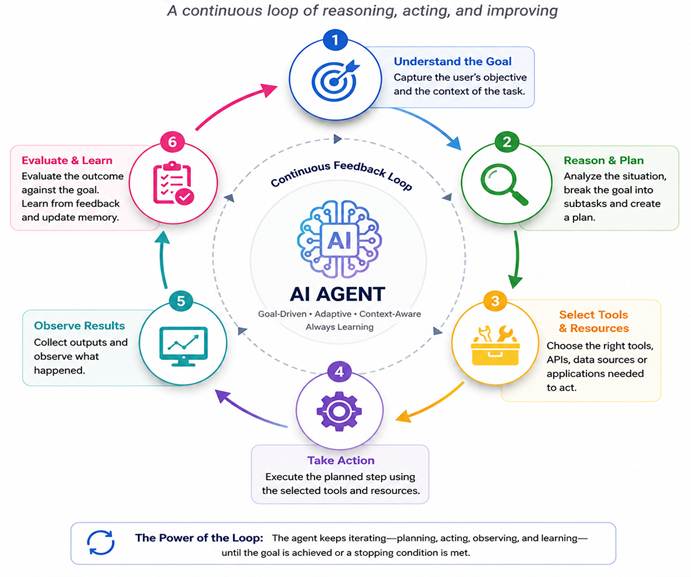
Figure 2: Basic Working of an AI Agent
Where Can AI Agents Be Used?
AI agents have potential applications across education, healthcare, software development, business, scientific research, and manufacturing. In education, they can provide personalized learning support. In software development, they can inspect code, write programs, run tests, and identify errors. In scientific research, agents could analyze literature, support experiment design, examine results, and suggest further experiments.
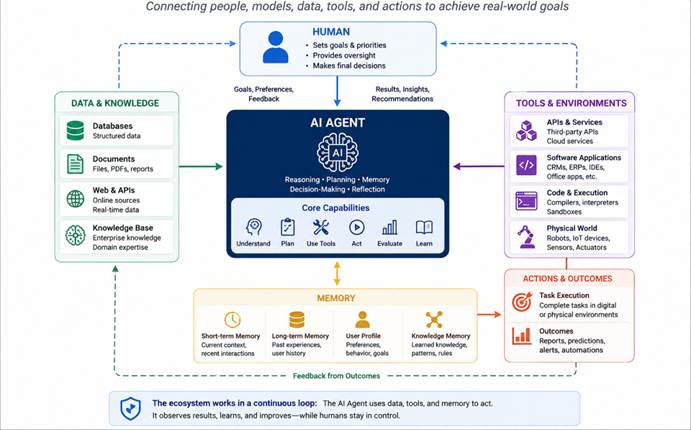
Figure 3: The AI Agent Ecosystem
The Future of AI Agents
The rise of multi-agent systems, where specialized AI agents collaborate on different parts of a complex task, represents another important development. However, greater autonomy also brings challenges involving reliability, cybersecurity, privacy, and accountability. Human supervision, appropriate permissions, monitoring, and verification will therefore remain essential.









 has evolved rapidly—from rule-based systems and machine learning to deep learning and Generative AI)