











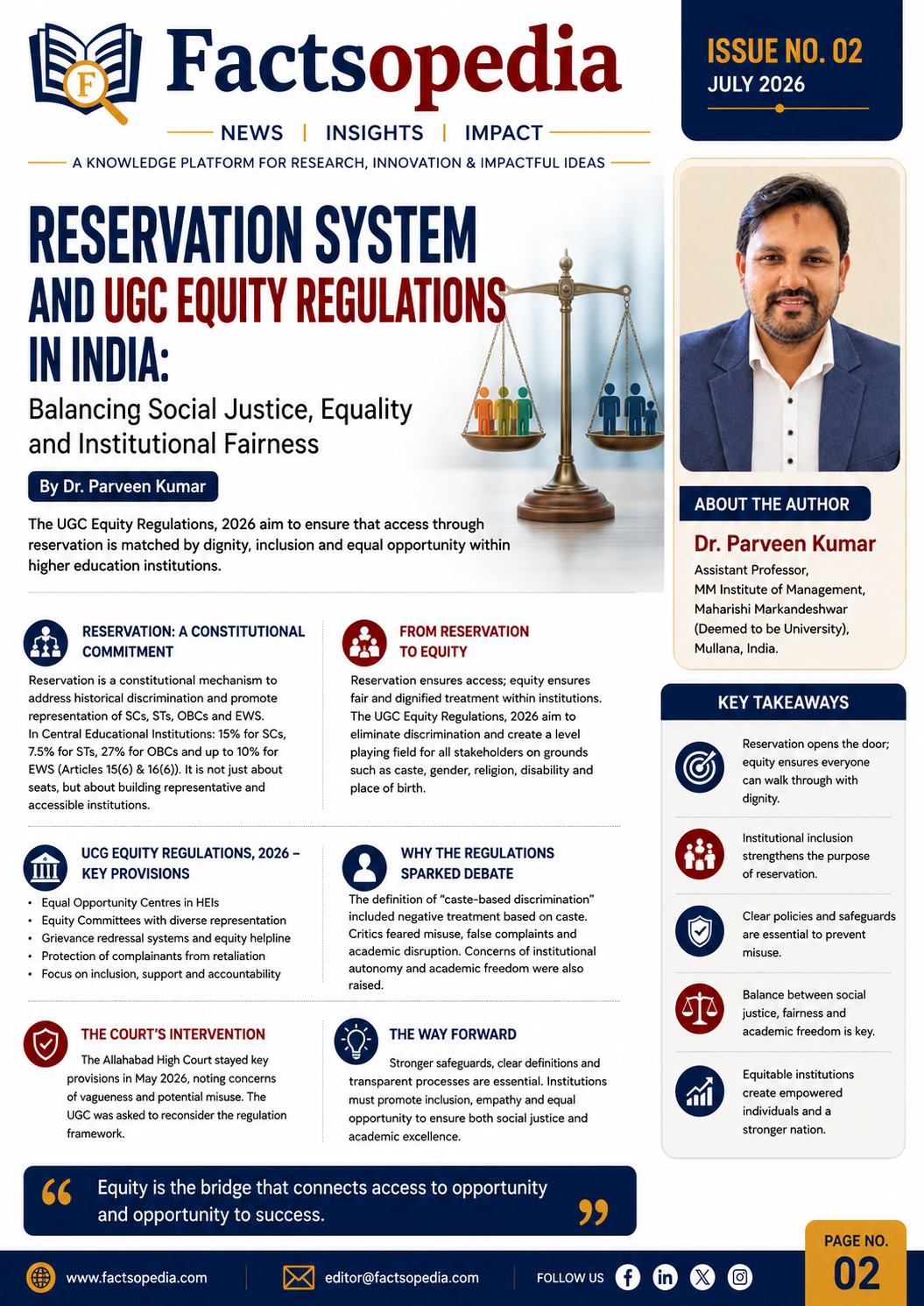
By Dr. Parveen
Assistant Professor, MM Institute of Management
Maharishi Markandeshwar (Deemed to be University), Mullana, India
Reservation System and UGC Equity Regulations – The debate surrounding the UGC Equity Regulations provides India with an opportunity to design a framework that simultaneously respects constitutional equality, social justice, institutional autonomy, individual rights and due process. India’s reservation system remains one of the most significant instruments of social justice in the country. Conceived as a constitutional mechanism to address historical discrimination, social exclusion and unequal access to education and public employment, reservation has played an important role in improving representation of disadvantaged communities. In higher education, however, the debate has gradually moved beyond the allocation of reserved seats to a broader question: Does access to an institution automatically ensure equality within the institution?
This question lies at the heart of the University Grants Commission’s efforts to promote equity in Higher Educational Institutions (HEIs).
The UGC notified the University Grants Commission (Promotion of Equity in Higher Education Institutions) Regulations, 2026 on January 13, 2026. The regulations were intended to strengthen institutional mechanisms against discrimination and promote equity and inclusion in universities and colleges. Their introduction generated an intense national debate about the relationship between reservation, caste-based discrimination, equality and fairness in Indian higher education.
Reservation as a Constitutional Commitment
The philosophy behind reservation is closely connected with the Indian Constitution’s commitment to both equality and social justice. Equality cannot always be achieved merely by treating every person identically when different sections of society have historically experienced vastly unequal social and economic conditions.
The Constitution therefore permits affirmative measures for socially and educationally disadvantaged sections. Over the decades, reservation policies have provided opportunities to Scheduled Castes (SCs), Scheduled Tribes (STs), Other Backward Classes (OBCs) and, more recently, Economically Weaker Sections (EWS).
In specified Central Educational Institutions, the reservation framework provides 15 per cent reservation for Scheduled Castes, 7.5 per cent for Scheduled Tribes and 27 per cent for Other Backward Classes.
The Constitution (103rd Amendment) Act, 2019 introduced provisions enabling reservation of up to 10 per cent for Economically Weaker Sections, subject to the applicable constitutional and statutory framework. The Government confirmed in August 2026 that Articles 15(6) and 16(6) enable this provision.
Reservation, therefore, is not merely a matter of distributing seats. It reflects the larger constitutional objective of making institutions more representative and accessible to sections that historically remained under-represented.
From Reservation to Equity
Reservation and equity, although interconnected, should not be considered identical concepts.
Reservation primarily creates access and representation. Equity seeks to ensure that people, after gaining access, receive a fair and dignified environment in which they can study, work and progress.
A student may enter a university through a reservation policy, but genuine inclusion requires that the student is not subjected to discrimination, humiliation, stereotyping or unequal institutional treatment.
This distinction makes the UGC’s equity framework particularly significant.
The 2026 Regulations defined equity as providing a level playing field for stakeholders to exercise legitimate rights and sought to eliminate discrimination on grounds including religion, race, caste, gender, place of birth and disability. They placed particular emphasis on groups including SCs, STs, socially and educationally backward classes, EWS and persons with disabilities.
What Did the 2026 UGC Equity Regulations Propose?
The regulations attempted to make universities more accountable for preventing discrimination rather than responding only after a serious incident occurred.
One of their important provisions was the establishment of an Equal Opportunity Centre in Higher Educational Institutions. Such centres were envisaged as institutional mechanisms to oversee policies concerning disadvantaged groups, provide academic, financial and social guidance and promote diversity on campuses.
The framework also envisaged Equity Committees to examine complaints of discrimination. Representation from Scheduled Castes, Scheduled Tribes, Other Backward Classes, persons with disabilities and women was required within the committee structure.
Other mechanisms contemplated included grievance-redressal systems, institutional accountability, an equity helpline and measures to protect complainants from retaliation.
These provisions reflected an important evolution in the debate on reservation. The discussion was no longer confined to “Who gets admission?” but extended to “What happens to students after admission?”
Why Did the Regulations Become Controversial?
The most debated aspect was the specific definition of “caste-based discrimination.” The 2026 Regulations defined it in relation to discrimination on the basis of caste or tribe against members of Scheduled Castes, Scheduled Tribes and Other Backward Classes.
Critics argued that grievance-redressal mechanisms dealing with discrimination should be sufficiently inclusive and should protect any person who experiences caste-based discrimination, irrespective of category. Concerns were also expressed regarding ambiguity in some provisions and the possibility of misuse.
Supporters of stronger equity regulations, on the other hand, emphasised that historically marginalised communities can experience structural and institutional forms of discrimination that cannot always be addressed through formally identical treatment. They argue that specific safeguards are necessary because unequal historical conditions continue to influence educational experiences.
Both perspectives raise questions that deserve serious deliberation rather than political polarisation.
Supreme Court Intervention and the Present Position
The legal position is particularly important for understanding the debate.
On January 29, 2026, the Supreme Court directed that the UGC Promotion of Equity Regulations, 2026 be kept in abeyance while constitutional challenges to the framework were examined. The Court expressed concerns that aspects of the regulations were prima facie vague and capable of producing sweeping consequences. It directed that the earlier UGC (Promotion of Equity in Higher Educational Institutions) Regulations, 2012 would continue to operate until further orders.
The matter has continued to evolve. On August 20, 2026, the Union Government informed the Supreme Court that the 2026 Regulations were being reconsidered. The Court sought a comprehensive response from the UGC while the regulatory review continued.
Thus, as of August 2026, the 2026 UGC Equity Regulations are not operational; the 2012 Regulations continue to remain in force pending further orders and reconsideration of the newer framework.
This distinction is essential because public discussions sometimes treat the 2026 framework as though it is presently being implemented.
Reservation Should Not Become a Source of Social Division
India’s reservation policy has always generated strong opinions. For some, it represents long-overdue corrective justice; for others, questions regarding merit, economic disadvantage, duration of affirmative action and changing social conditions remain important.
Higher education institutions should not allow these differences to create hostility between students belonging to reserved and unreserved categories.
A student admitted through reservation should never be viewed as academically inferior merely because of the category through which admission was obtained. At the same time, students from the general category should not be stereotyped or treated as collectively responsible for historical discrimination.
Universities should cultivate an environment in which social justice and individual dignity reinforce each other rather than compete with each other.
Merit and Social Justice Need Not Be Opposites
One of the most common misconceptions surrounding reservation is that social justice and merit necessarily stand on opposite sides.
Merit is influenced by access to quality schooling, family income, language, geographic location, digital resources, social networks, coaching facilities and many other circumstances. Two students may possess equal potential while receiving very unequal opportunities to develop that potential.
Affirmative action attempts to address some of these structural differences.
At the same time, institutions must continually strengthen academic support, bridge courses, scholarships, mentorship, career guidance and skill-development programmes so that inclusion translates into sustainable academic achievement.
The objective should not simply be to reserve opportunities, but also to create capabilities.
The Way Forward
India needs a balanced equity framework that is strong enough to prevent genuine discrimination but precise enough to prevent arbitrary or malicious complaints.
An effective future UGC framework should therefore guarantee protection against discrimination, establish independent and time-bound grievance-redressal procedures, ensure confidentiality and protection against retaliation, and simultaneously incorporate principles of natural justice for everyone involved.
Universities should maintain transparent procedures for receiving and investigating complaints. Decisions must be evidence-based rather than driven by assumptions about caste or social background.
Regular sensitisation programmes for students, faculty and administrative staff can also play an important role. Equity cannot be achieved merely by establishing another committee. It requires a transformation in institutional culture.
Most importantly, India’s higher education system needs to move beyond a narrow debate of “reservation versus merit.” The real challenge is to build universities where talent can emerge from every social and economic background.
Towards an Inclusive University System
Reservation opened the doors of institutions to millions who may otherwise have remained outside them. The next stage of educational reform must ensure that once those doors are opened, every student entering through them is treated with dignity and provided with genuine opportunities to succeed. Reservation System and UGC Equity Regulations – The debate surrounding the UGC Equity Regulations provides India with an opportunity to design a framework that simultaneously respects constitutional equality, social justice, institutional autonomy, individual rights and due process.
A truly progressive university is neither one that ignores social inequalities nor one that allows social categories to permanently divide its academic community.
The ultimate objective should be a higher education system where reservation provides opportunity, equity guarantees fairness, merit is cultivated, discrimination is rejected and every learner is judged by his or her potential, contribution and character.
That balance—not social confrontation—should define the future of equity in Indian higher education.